


THE 4-YEAR-OLD CLASS
THE FUNDAMENTAL PILLARS OF OUR CLASS ARE: MOTIVATION
CREATIVITY AUTONOMY
METHODOLOGY
HOW DO WE ORGANISE OURSELVES? The dynamics of our class are based on a work to:
1. CORNERS Work by corners is a methodology that consists of organizing the classroom in several spaces, where students distributed in small groups, carry out simultaneous activities autonomously
“WORKING IN CORNERS IS EDUCATING AUTONOMY”
We can distinguish between Directed Work Corners and Playful Corners, but both situations, work or play, are always rich learning spaces for students:
In the directed work corners we propose activities that are more limited, respond to a more scheduled content gradation and that need some registration system by the teacher to ensure that all students have completed them. Students must be clear about the expected result of their activity. Normally we work with a weekly work wheel system and it is carried out by the four groups that make up the class.
Our directed work corners are:
- Asembly.
Mathematics or numbers.
Language or letter.- Arts.
Stroke and graphics.- PDI.
Work project.
Drawing (not plastic).
- Els racons lúdics presenten activitats més obertes, en les quals els alumnes tenen més llibertat d’acció i de focalitzar els seus interessos. Hi desenvolupen l’activitat al seu aire realitzant una acció més manipulativa i d’experimentació amb el material.
HOW DO WE ORGANISE OURSELVES?
The dynamics of our class are based on a work to:1. CORNERS
Work by corners is a methodology that consists of organizing the classroom in several spaces, where students distributed in small groups, carry out simultaneous activities autonomously
“WORKING IN CORNERS IS EDUCATING AUTONOMY”
We can distinguish between Directed Work Corners and Playful Corners, but both situations, work or play, are always rich learning spaces for students:
In the directed work corners we propose activities that are more limited, respond to a more scheduled content gradation and that need some registration system by the teacher to ensure that all students have completed them. Students must be clear about the expected result of their activity. Normally we work with a weekly work wheel system and it is carried out by the four groups that make up the class.
Our directed work corners are:
- Asembly.
Mathematics or numbers.
Language or letter.- Arts.
Stroke and graphics.- PDI.
Work project.
Drawing (not plastic).
The playful corners present more open activities, in which students have more freedom of action and focus their interests. They carry out the activity at their own pace, carrying out a more manipulative action and experimentation with the material.
Our free play corners are:
Constructions.
Puzzles.
Plasticine.
Our free play corners are:
Constructions.
Puzzles.
Plasticine.
Games at home.
Arener.
Light table.
The Tent/Kitchen.
Work project.
Library.
2. BY WORK PROJECTS Project work is a methodology that allows students to think, investigate, learn from their mistakes, from their classmates and thus encourage criticalism. The theme chosen for each project can be done in different ways:
A center of interest that affects the life of the school.
An idea or experience of a child.
A classroom-related event.
A proposal carried out by a teacher.
Early childhood teachers are always looking for an attractive way to introduce the topic: for example, a film that refers to the topic we are going to work on, an invented character, a magic box, a letter, an email, a news item… The methodology for carrying out projects in early childhood education follows the following scheme:
-
A topic is chosen. Previous knowledge is searched “What do we know?”
The topics you want to discover are raised, “What do we want to know?”
We begin to look for information to solve the challenges posed.
A conceptual map or work index is created.
It is reflected continuously about what we have learned and how we have learned it.
The learning carried out is shared and a network of contents is built.
Throughout the project, new topics are continuously emerging to discover and we treat them according to the interests of each group.
The project ends with a dossier that includes the different experiences, experiences, activities, reflections, photographs,… that have been developed throughout the project itself.
PROJECTS WORKED ON IN 3 YEARS
THE DINOSAURS GIRAFFES SHARKS
PROJECTS WORKED 4 YEARS
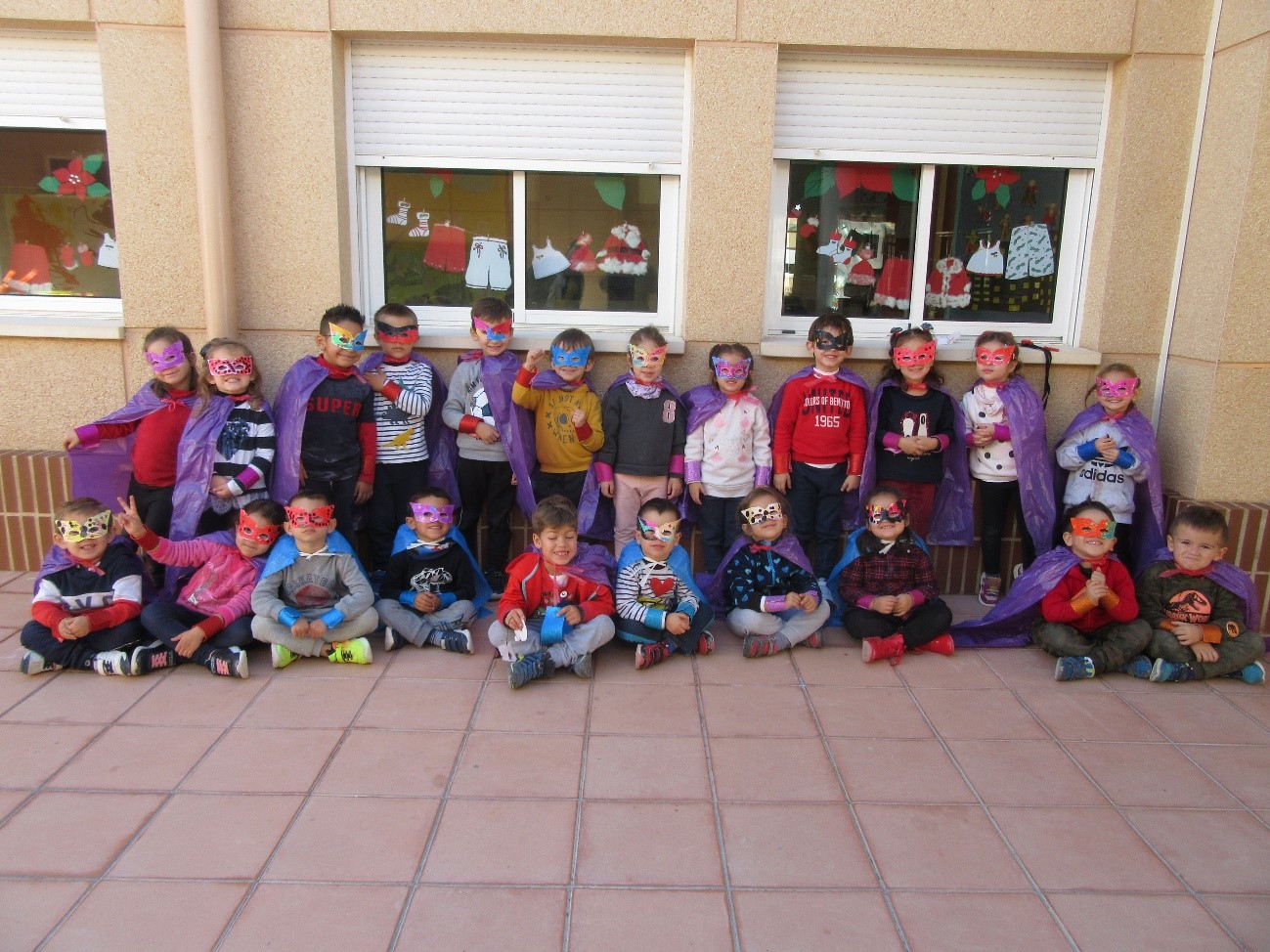
“SUPERHEROES AND SUPERHEROINES”
“KNIGHTS AND PRINCESSES”
OTHER ANNUAL PROJECTS
Annual Recycling Project.
Objective: To learn about the different recycling containers.
Annual Healthy Breakfast Project.
Objective: To acquire healthy eating habits.
Annual Project: “Our Body”
Objective: To record the evolution in the acquisition of the body scheme and to detect and prevent difficulties at an early age through development, movement and psychomotor capacity.
ACTIVITIES WITH THE FAMILY
1.Storytelling. Every Friday the children take home a story, either from the classroom library or from the school library. The story will be returned after the weekend, after reading it with the family at home.
2.Travelling Book. This year the travelling book of our class is dedicated to learning the letters of the alphabet. Every Friday a boy or girl will bring home the book with a letter from the alphabet, decorate it freely, look for words with that letter and on Wednesday he will explain it to his classmates at the assembly.
3. Game: The Box of Surprises. Every Tuesday a boy or girl will take home a box to put in a surprise (a toy, a small story, an animal, any object). In class we will try to guess the surprise and then we will make a drawing of it. Then we will use this activity to work on the children’s spontaneous writing.