
PHASE 1. Initial decisions: team and methodology
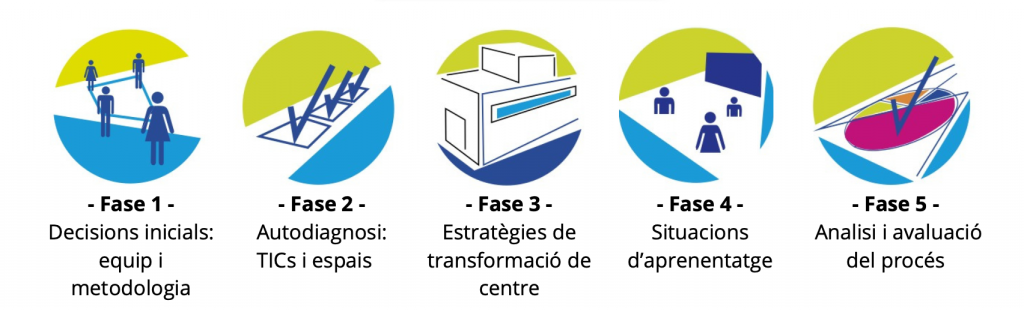
The educational improvement process through Aulas Transformadoras consists of a series of phases that are built and implemented consecutively until a sustainable, innovative learning environment is created. In this section, we focus on Phase 1: Initial Decisions: Team and Methodology, which is divided into the following steps:
1.1. AT Team and Commission
In this step we must differentiate between two human groups that may or may not be different, depending on the specific circumstances of each center:
- The AT Commission: is a small group of teachers who will lead the training process, making decisions and proposing tasks to be completed.
- The AT team: a broader group of teachers, including all those who wish to implement an innovation along the lines of Aulas Transformadoras. This group is part of the AT Commission, but may be broader when it involves specific departments, cycles, or teaching staff.
1.1.1. Constitution of the AT Commission
The beginning of the innovation process corresponds to the creation of the AT committee, the small group of people who will lead the training process for the entire team involved. This committee will be created initially to then seek interested people, or it can be created the other way around, selecting some members from the group of interested people. A possible composition proposal for this committee is as follows:
- At least one member of the management team
- The TIC coordinator
- One person from each cycle, area or department.
The AT committee ensures that each and every person involved feels part of the project and develops a sense of ownership that ensures its sustainability over time. This committee will be responsible for coordinating the transformation process throughout the various phases and will organize activities and propose tasks aimed at consolidating the work carried out during these phases.
Without the committee of people driving the innovation process and the team involved, the transformation would not be possible, which makes the human factor just as important as the methodological, spatial, or technological aspects. Without people, without their interest and motivation, the Aulas Transformadoras project would be meaningless.
1.1.2. Creating the AT Team
The AT Team is comprised of all the individuals (teachers at the school) involved in the change process of applying Transformative Tools at their school. This can be a group of teachers (e.g., at the school level, department, cycle, etc.) or the entire faculty. They are the people who execute, the architects of the change, and within this team is the AT Committee, which leads the process. For example, if it is linked to a training activity (PFC or Seminar), the AT Team would be the group of speakers, coordinator, and assistants, while the AT Committee would be the people who coordinate or present the different phases to be carried out.
As mentioned before, each center is different, and the change process may have begun by first establishing an AT Committee or, conversely, by bringing together all the teaching staff interested in this process, and then selecting those who will lead the process from this group
Both the Team and the AT Commission will be supported and reinforced by different members of the educational community belonging to the following groups:
- Faculty members belonging to different educational cycles and levels.
- Management team.
- People in charge of the different center coordinations.
- Student body.
- Families.
- External agents and alliances with the educational community in the broadest sense: suppliers, collaborating entities, etc.
1.1.3. Initial decisions
When creating the AT Commission and the AT Team, it may be appropriate to make a number of decisions, which are detailed in the following list:
- List of members.
- Image and phrase/quote that defines the commission.
- Justification for participation in the Aulas Transformadoras innovation process.
- Planning work sessions (see next paragraph)..
- Give the project a name.
- Analysis of the starting reality.
- Distribution of roles among the members of the Commission. Some examples are:
- Secretary
- Spokesman
- In charge of dissemination
- Responsible for the documentation of each phase
In order to schedule the work and the change process, it is recommended that the AT Committee, in coordination with those deemed relevant (Training Coordinator, Management Team, etc.), establish a work schedule and objectives to be achieved throughout the course. It is important to answer these questions:
- How far do you want to go in implementing the Transformative Tools phases?
- In what times?
- How many meetings will there be?
- On what dates or how often?
This planning consists of creating a timeline and content schedule similar to that used when coordinating a seminar or training project in centers. This schedule should be shared with the rest of the AT team and the center’s management team.
1.1.4. Dissemination: creation of Aulas Transformadoras Spaces
Finally, to give visibility to the work done, it is proposed to create an AT Space somewhere in the center, where the work being done and the results obtained can be compiled, in the form of a timeline or similar. This will facilitate greater transparency so that other members of the educational community can learn about it if they wish. Several guidelines for this AT Space:
- Physical space:
- Locating a visible place in the center.
- Labeling of the space.
- Preparation of the timeline in which the work carried out in each phase of the process will be updated.
- Virtual space:
- Creation of a section for the project on the center’s website.
- Content planning.
At the same time, it’s helpful to share what will be done or is being done at a faculty meeting so that teachers are aware of the work done within the Aulas Transformadoras innovation process and the AT Committee. The teaching faculty is generally considered the appropriate setting for disseminating the project’s tasks and phases.
1.2. Selection of interests
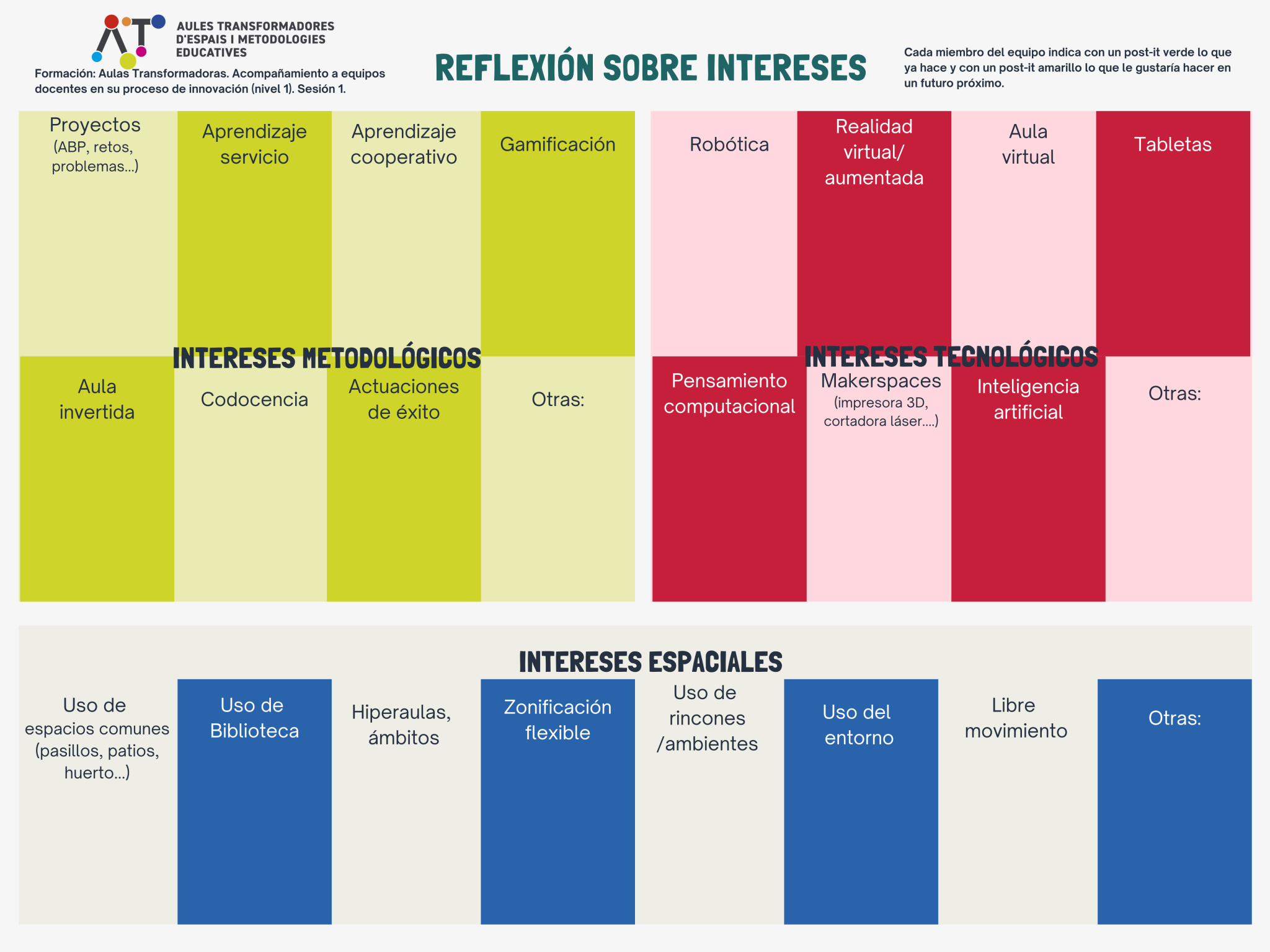
The Aulas Transformadoras innovation process is based on the use of active teaching methodologies, which will in turn affect the use of educational technology and spaces. No specific methodologies are promoted; rather, any methodology or strategy is valid if it appeals to teachers and meets the needs of both teachers and students and the subject(s) in question. Therefore, the first step the AT Team will take is to reflect on the active methodologies they use and would like to use, in order to select those that will be the protagonists of the innovation process.
1.2.1. Reflection and selection of interests
To carry out this reflection and subsequent selection, different dynamics can be implemented, all of which have in common the launching of a series of questions to the faculty to guide the process:
- What methodologies do we know?
- Which ones are currently most used in the educational system?
- Which ones are we interested in developing?
- Which ones best suit my personality, my students, and my subject?
- What technology and spaces are linked to this methodology?
A possible dynamic to carry out this reflection is proposed below:
Using this plantilla, for example, projected on a whiteboard or using it as inspiration to make a diagram on a continuous piece of paper or similar, invite each teacher to indicate the following with post-its of different colors (those mentioned below are guidelines as an example):
- Yellow: Methodologies, technology, and spaces that are already being used when designing the teaching and learning process.
- Green: Methodologies, technologies, or spaces that each person would like to implement in their classroom work in the near future.
The teachers involved can comment on what appears on the collaborative mural, clarifying issues or sharing reflections. Once this has been shared, it’s a good idea to select the group that will guide the innovation process. To do this, the AT Team will divide into subteams based on the expressed interests: those who have posted their green Post-its on the same methodology will join together to carry out their innovation process along those lines, reflecting on the technology to be used and making the most of the available space.
These decisions constitute the foundation upon which innovative improvement and transformation in the classroom and the school are built. The methodology, along with the methodological and spatial strategies selected accordingly, will guide the process of developing learning situations and school projects in subsequent phases.
1.2.2. Definition of interests
Once each subteam has a clear understanding of the methodology they want to serve as the basis for their innovation process, the technology involved, and the spaces available, it’s a good idea to spend some time researching and properly defining what all this means:
- What is the methodology?
- What characteristics does it have?
- What phases are usually used to apply it?
- What technology (devices, apps, and websites) can help implement this methodology?
- What spaces can support this methodology?
These considerations are compiled in an individual document for each subteam, which will be shared with the rest of the AT Team so that anyone can use it. It will also serve as a basis for conducting self-assessment and designing the learning situation in the subsequent phases of the innovation process.
1.3. Phase 1 Documentation
To document the innovation process and facilitate reflection on everything accomplished, both during and after the process, we suggest completing the attached document, compiling the various steps taken.
PHASE 2. Self-diagnosis: spaces and technology
In this second phase of the Aulas Transformadoras innovation process, the main objective is for the AT Committee, together with the AT Team in the case of those centers where one has been created, or the entire faculty if so decided, to reflect and analyze their current situation in order to make decisions about the next steps to take in their innovation process. To do so, using the methodologies selected in Phase 1 as a reference, the different subteams will use the proposed material to identify their current level of innovation. Once identified, the steps to be taken to achieve a feasible and sustainable innovation can be designed in subsequent phases.
To facilitate reflection, a tool has been created that identifies five essential dimensions in any educational innovation process, and five levels of innovation within each of those dimensions.
2.1. Self-Diagnosis Guide
The essential tool for this phase is a document that includes five pages, one for each dimension to be analyzed. This material provides a wealth of information about the pedagogical use of technology, spaces, and methodologies.
The following is a detailed description of each of the five dimensions:
- Student body: the role of the student in his or her own learning is analyzed according to his or her way of working, the level of decision-making and responsibility, as well as the use of educational spaces and available technology.
- Faculty: an analysis is carried out on the degree of use of active learning methodologies in teaching, the digital competence of the student, and the use of different spaces in the classroom and at the center.
- Pedagogical objectives and evaluation: the relationship between these objectives and the methodology used in the teaching-learning process, the inclusion of technology in the process, and the use of flexible spaces both inside and outside the classroom are observed.
- The center’s capacity for innovation: analysis of the training provided at the center, as well as the management team’s support for innovation in the three fundamental aspects of the process (methodology, technology, and spaces).
- Resources: reflection on the availability of technological and spatial resources for the development of active methodologies. .
One proposal is for the subteams created in Phase 1 to work on this document. This will facilitate the identification of specific actions that can be taken to improve the level by relating them to the previously selected methodology. To perform this self-assessment, the following steps are proposed:
- Read the document in order to understand its organization.
- Individually, or at the group or center level, choose dimension by dimension the level of the center in general, the team analyzing it, or the individual. That is, you should check which levels have already been passed and what the current level is, keeping in mind that 1 is the lowest level and 5 the highest.
- Fill out the analysis table attached to the documentation section. The level description itself helps identify strategies that can be implemented to advance to the next level.
2.2 Documentation
Based on the reflections made using the self-assessment guide, the following summary table will be completed, which will provide evidence of the work carried out throughout the innovation process. If this was done in subteams or individually, each team will create a separate table.
The information gathered in the Level Up Actions column should be linked to the methodology selected in Phase 1. This information will be taken into account for subsequent decision-making in Phases 3 and 4.
| Current level | Description of current reality | Actions to level up | ||
| A | Student body | 3 | My students decide their own learning objectives… | |
| B | Faculty | |||
| C | Pedagogical objectives and evaluation | |||
| D | The center’s capacity for innovation | |||
| E | Resources |
PHASE 3. Transformation strategies
Currently, the AT team is at the point where it can begin making decisions. Each teacher or subteam already knows what they want to do (the selected methodology) and is clear about the actual modification to be introduced in their classroom based on the self-assessment (based on their current level and the one they are choosing). Now, before designing a learning situation that will make the innovation a reality, they need to know, at the organizational and resource levels, what they actually have available.
It’s time to reflect on what issues have been identified that need to be modified to facilitate work along the proposed lines.
3.1. Technical and organizational issues
Often, the learning situations designed require issues that may not be common in the center: two teachers working together in the classroom (co-teaching), a schedule with consecutive sessions to be able to carry out the situation with the fewest possible interruptions for a limited time… Thus, some centers request changes to the management team in the following:
- Schedules:Having a full afternoon per week for interdisciplinary projects; having one week per term to work on interdisciplinary projects instead of subjects; adjusting the number of free teachers to provide real co-teaching; presenting desiderata for teamwork or participating in school projects (PIIE, European projects, etc.).
- Organization: create a schedule/shift/rotation for the use of common spaces.
- Conectivity: an increase in bandwidth, Wi-Fi hotspots in poorly connected areas…
- Coordination:regular coordination meetings between teachers involved in the implementation of interdisciplinary learning situations.
- Diffusion: time reserved for some faculty and school councils, a fair open to families, and space on the school’s website…
Section 3.6 contains a template for compiling these questions, which can be used as a conclusion for a teaching session.
3.2. Training
The AT team must consider and gather the training needs of its members and organize it either as self-training, leveraging the team’s own knowledge and talents, or as external training, within or outside the Annual Training Project (PAF). Training ideas:
- Training in methodologies: theoretical presentation, creative workshop, visit to colleagues or centers that already work in this way… It may be interesting to receive training in the action research methodology.
- Technology training: technical training, practical application workshop, visits to colleagues or schools that use the technology of interest…
- Training on the use and design of educational spaces: reading a document together, reflecting on the elements to consider, visiting colleagues or schools that use their spaces in innovative ways, etc.
These training needs should be compiled and transmitted to the Management Team and the PAF coordinator, indicating the desired training topic, the participants (external or internal speaker), and the ideal timing. To do this, you can fill out the corresponding section of the template provided in section 3.6.
3.3. Space design
Active methodologies often require or allow students to work away from their individual desks, allowing them to organize themselves into groups and use tables or not, for example.
Based on the reflections made in the previous phases, the next step is to design the space in which learning would take place, as a model. Each teacher, keeping in mind the classroom in which they typically work, will create a model of how they would like it to be for this learning situation. We invite the TA Committee or Management Teams to carry out the same reflection for other spaces in the school (hallways, halls, stairwells, library, multipurpose room, playground, garden, etc.).
To design these spaces, the following will be taken into account:
- Lightning: promoting natural light, ensuring that there is adequate and sufficient artificial light, which can, at least, be controlled individually by classroom (the entire classroom in one go, in part, adjustable, etc.).
- Sound: consider which elements of the classroom will help absorb sound, minimizing echoes, for example.
- Decoration: the use of colors creates very different sensations in people and their well-being. It’s worth reflecting on whether or not using calming colors or more powerful colors is appropriate. It’s also important to consider including natural elements (e.g., plants) to enhance well-being.
- Furniture: it is important that it is as flexible as possible, quiet, easy to clean, as stackable as possible, safe according to European standards and comfortable.
- Storage: order is essential to help maintain calm and well-being, so it’s necessary to have storage space for work materials, but also for backpacks or coats. It’s important to consider this element, which can hinder free movement, making it easier to rearrange furniture, and so on.
- Amount: overly cluttered spaces negatively impact people’s well-being and attention span. Therefore, the number of elements desired in the space must be carefully designed (less is more).
- Zoning: dividing the classroom into work zones, as in Aulas Transformadoras, is not a requirement. Each teacher must consider whether such zoning is appropriate or not, which zones they would include, and why. But we must never forget that the zones are linked to certain 21st-century skills we wish to develop in our students. Therefore, the classroom may not be zoned, but rather there may be different spaces within the school that allow us to work on these skills: for example, there could be a classroom in which to work on the skills of Developing, Sharing, and Connecting, while there would be a Create room, a Research room, and a Display area distributed throughout the school. Sometimes, certain elements can be identified that will orient the furniture toward a specific location, with a specific layout, allowing us to focus on a specific skill without creating static zones.
For the creation of the models, the following digital tools are proposed:
- Drawisland (Nivel iniciación) En inglés.
- Homebyme (Nivel medio) En español.
- Sweethome3d (nivel medio) En español.
3.4. Material resources
After reflecting on the desired space for the proposed situation (and any subsequent ones), it is advisable to compile a list of the actual modifications you wish to make to the school’s spaces, starting with the classroom but not forgetting hallways, playgrounds, and common areas.
You are encouraged to make a list of what you would remove from the classroom or area being analyzed, what you would modify, and what would need to be acquired. It is a good idea to send this list to the AT Committee, which will then forward it to the school’s Management Team. Technology should not be overlooked in this list. A template for compiling these questions is found in section 4.6.
3.5. Action plan
aking into account everything gathered in this phase, the management team is asked to establish transformation strategies and time them to fit the current situation of their center, taking into account the PGA and budgets. These strategies reflect the commitment to the AT team, identifying deadlines and responsibilities, to implement some of the requested changes.
To implement this action plan, they will meet with the AT Committee as many times as necessary (at least once initially so that the Committee can share the work done in this phase and again after the Management Team has assessed the options and verified the corresponding budgets or permits). A document is provided in section 3.6 to structure this action plan.
3.6. Documentation
In this fourth phase, the documentation will include the organizational issues identified as necessary, the models of the designed spaces and the list of material resources, as well as the action plan developed with the Management Team. For this purpose, we provide you with a base document.
Documento
PHASE 4. Learning situations
After analyzing our reality and making the appropriate decisions regarding adequate strategies for the functional development of our center, it is time to design the
Learning situations (LS). . This phase 4 will help us collaboratively prepare an SA adapted to our students.
4.1. What is a learning situation?
The LS they involve recreating real-life classroom contexts so that students can respond to challenges or problems and develop learning through a competency-based perspective. The goal is to offer students the opportunity to connect learning experiences and apply them in contexts close to their everyday lives.
A LS can involve several areas of knowledge to analyze the complexity of reality.
LS’s are included in the classroom program.
4.2. Guidelines for the design of Learning Situations.
Having reached this point of reflection carried out in the previous phases, our AT team already knows:
- What you want to do (selection of interests: methodology, spaces, and TIC). Phase 1
- What is the starting level and where and how do we want to get to the next level? Phase 2
- What center transformation strategies can be considered? Phase 3
With all this, now in Phase 4, it’s time to design SAs that will help us transform our classrooms and our centers. To do this, we must consider:
- The pedagogical proposals of each cycle or department to continue with the center’s pedagogical line.
- The three pillars of the AT project (methodology, spaces, and ICT) to proactively respond to the interests selected in Phase 1.
- Universal Design and Accessible Learning (UDA-A) for the design of learning contexts that respond to student diversity.
- Working meetings to ensure the participation of all teachers, essential debate to reach the necessary agreements, and good coordination to achieve a coherent and effective educational process.
Based on these premises, it is appropriate to pose a challenge or problem, the creative resolution of which involves the integrated mobilization of basic knowledge through the completion of different tasks and activities.
It is important that challenges are well contextualized and based on meaningful experiences for the students, planned in specific environments, and where interaction with others is essential.
4.3. Guidelines for the design of Learning Situations.
It is time for each subteam to design its own LS. To do so, a template is provided plantilla which can serve as a basis, always adapting it to your particular needs or interests. The template includes a brief explanation of the information to be collected in each section.
Once the LS has been designed, each group is invited to self-evaluate their own proposal, based on the following: rúbricas . This document is based on the idea that students should be facilitated in the development of 21st-century skills . An LS does not necessarily have to include all of these competencies, but it is interesting that it includes most of them and always those related to the DUA-A. The goal is to achieve the highest level for each question. Therefore, if this is not the case, it is advisable to reflect as a group on what can be modified or improved to make a more appropriate proposal.
A document is provided in section 4.6 to record this self-assessment and subsequent reflection.
4.4. Enrichment dynamics
Once each subteam has developed a SA related to their identified interests, taking into account the initial and desired levels and the organizational measures provided by the center, it is proposed to carry out a dynamic, prior to implementation in the classroom, to enrich this situation.
In this dynamic, at least one member of the subteam will stand at a specific point in the space and will be responsible for explaining the designed SA to the rest. The remaining subteam members should move around the space, approaching representatives of other groups to explain the situation they have designed. Each person responsible for explaining the situation will have sheets of paper, pens, or sticky notes of different colors, on which each teacher will write the following information:
- In red, the problems, difficulties or barriers that you observe in the learning situation you are discovering
- In green, the possible solutions to the problems, difficulties or barriers that have been observed..
- In yellow, resources (analog, digital, spatial, personal, etc.) that are not initially included in the LS but which, based on experience, may be useful at some point.
- Orange indicates ideas, extensions, or related proposals not initially considered, so that the design subteam can consider adding them to this one or taking them into account when designing a higher level of complexity in the future.
Ideally, each teacher should be familiar with at least two LS’s other than those designed for their own group.
Once this dynamic is completed, the SA will be implemented in the classroom.
4.5. Evaluation of the learning situation.
Each LS designed and implemented will include an evaluation throughout its implementation. This evaluation will allow for any necessary modifications to ensure the learning objective is achieved. It will also be used as a report, providing a comprehensive overview of the LS.
It is recommended that this evaluation include the identified strengths and barriers, a reflection on the teaching practice itself, and suggestions for improvement for the design of future LS’s.
4.6. Documentation
As a record of what has been done, it is recommended to include in the documentation the LS’s themselves, as well as evidence of the self-assessment and subsequent reflection and the enrichment dynamics. A scheme is proposed in this document. documento descargable.
PHASE 5. Analysis and evaluation of the process
The final phase of the kit has arrived, and now it’s time to take stock of the process followed and the results achieved so far. The objective of the analysis should be for you to reflect on what has worked for you and what hasn’t, as well as to determine your strengths and weaknesses. All of this should help you learn from the experience and make decisions for continuing the transformation process you began during this academic year.
Over the past few months, you have been documenting the actions taken, and this provides you with valuable data that you can now analyze to draw relevant and useful conclusions for this process.
When conducting this evaluation, you must consider several aspects:
- The process followed.
It’s about being able to describe and reflect on the transformation process that has been initiated and carried out, with the intention of determining the starting reality, what has been achieved, and what remains to be done.
- The proposal designed and implemented.It is about making explicit the action plan carried out and, more specifically, the design and implementation of the learning situations.
- The impact on students. It is about understanding to what extent the learning situation(s) have promoted and facilitated the learning of all students.
It’s about being able to describe and reflect on the transformation process that has been initiated and carried out, with the intention of determining the starting reality, what has been achieved, and what remains to be done.
5.1. What to evaluate
We’re going to help you evaluate the different stages you’ve gone through in the process.
To do this, we propose some questions to reflect on in relation to each stage worked on and the aforementioned dimensions:
- The process:
In phase 1,
- Has the center’s AT commission energized the start of the transformation?
- Has the rest of the team been actively involved?
- Have the spaces created to promote the project been used and have they been beneficial?
- Have subteams been formed that are interested in various methodological aspects?
- Have the selected interests been adequately defined?
In phase 2,
- Was the self-diagnosis helpful? Did you gain any relevant information?
- Did you disseminate the findings?
- With the actions carried out, have you managed to level up in the different dimensions?
In phase 3,
- Were appropriate decisions made regarding technical and organizational issues?
- Were the identified training needs addressed?
- Was any space designed and was the necessary resources considered?
- Has an action plan been designed and agreed upon with the center’s management team?
- Has the action plan been implemented on time and within the original goals? What has been done, and what remains to be done?
In phase 4,
- Did the learning situations capture the trends that interested you?
- Did the team that designed each learning situation analyze it?
- Was the dynamic of sharing different learning situations useful?
- Have the designed learning situations been implemented?
In phase 5,
- Has the documentation of each phase of the process facilitated its analysis?
- Do you consider the questions we pose in this section, “What to Evaluate,” to be useful and sufficient?
- Do you think you are capable of finding or designing tools to collect the information you need?
- Have you been able to analyze the data available to you to draw conclusions and make suggestions for improvements to continue the process you started?
- The proposal
- What predisposition and prior experience did teachers have in using active methodologies and TIC in the educational process?
- Did the learning situations you designed capture the trends that interested you?
- What obstacles have arisen?
- Regarding the level of teacher satisfaction with the work done, what did you like most and what do you think needs to be changed?
- Regarding the perception of student satisfaction, how have students received this way of working?
- How do families value this teaching model?
- The impact
- Which students were the learning situations applied to? (Define ages, students by group, etc.)
- What were these students’ characteristics? (behavior, commitment to learning, etc.)
- Has there been a change in the above aspects with the use of a more active and learning-centered teaching approach?
- Have students shown increased interest in learning and participating in the proposed tasks and activities? (It’s a good idea to reflect with students on what they’ve learned and how they learn best.)
- If you have used TIC, has it facilitated learning?
5.2. How to evaluate
In this section, we offer a variety of different tools that can help you gather the information you need to conduct the assessment.
Choose the ones you prefer.
- Self-reflection journal: By asking a series of questions, the teachers involved in implementing the activity can analyze how it worked: how the students and teachers felt while doing the activity, what problems arose, and how they were resolved.
- Peer observation: if another teacher involved in the design of the activity or the innovation process is invited to observe its implementation in the classroom, this person can provide feedback on what can be improved.
- Checklist: The activity design team can create a list of 5-10 items, answered in a yes/no format, on important issues to consider when implementing and evaluating each activity. This list can be completed by the person involved or by an external observer.
- Rating scale: similar to the checklist but answering on a rating scale: never – sometimes – often – always, for example.
- Survey or questionnaire: this tool can be used to involve students or all teaching staff in the evaluation of the activity. Item formats can vary widely: multiple choice, yes/no, rating scales, open-ended questions, etc.
- Rubric: In table form, the first column contains indicators of what we want to evaluate about the activity (criteria), and the first row contains the classification scale. In each box relating this column and this row, the degree of quality to be taken into account and how the activity can be assessed in that aspect are defined. This is a detailed evaluation.
5.3 Documentation
Below is the document containing the reflections and conclusions.
Documento