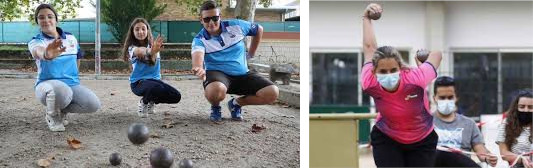

Fun facts about pétanque
The game in its current form emerged in 1907 in La Ciotat, Provence, in the south of France, although the ancient Romans already played a primitive version with stone balls, which was brought to Provence by Roman soldiers and sailors. Its name comes from the Occitan expression “pèd tanca” (“feet together”).
Educational objectives of playing pétanque
- Encourage team spirit and camaraderie.
- Learn to be patient during the game.
- Learn to create a pleasant and disciplined playing environment.
- Acquire and develop skills related to accuracy, technique and game strategies through continuous practice.
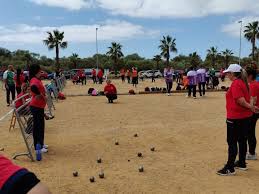
Playing area
- The game can be played on any type of surface, although it is normally played on flat, gravel or sandy areas.
- Courts are rectangular and, in national and international competitions, must have minimum dimensions of 15 m long × 4 m wide. For other competitions, they may have minimum dimensions of 12 m × 3 m.
- In competitions where the playing area is marked out, the courts are delimited by lines or strings marking the playing area.
Game formats
| Format | Players | Categories |
|---|---|---|
| Singles | 1 vs 1 | Children, youth and seniors |
| Doubles | 2 vs 2 | Children, youth and seniors |
| Triples | 3 vs 3 | Children, youth and seniors |
To play pétanque, you need:
- A small wooden or synthetic ball, called the jack or cochonnet.
- Three metal boules per player in singles.
- Three metal boules per player in doubles.
- Two metal boules per player in triples.
- A small cloth for cleaning the boules, especially when playing on muddy or damp ground.
- A tape measure for measuring distances.
- A throwing circle, which can be made of plastic or a similar material.
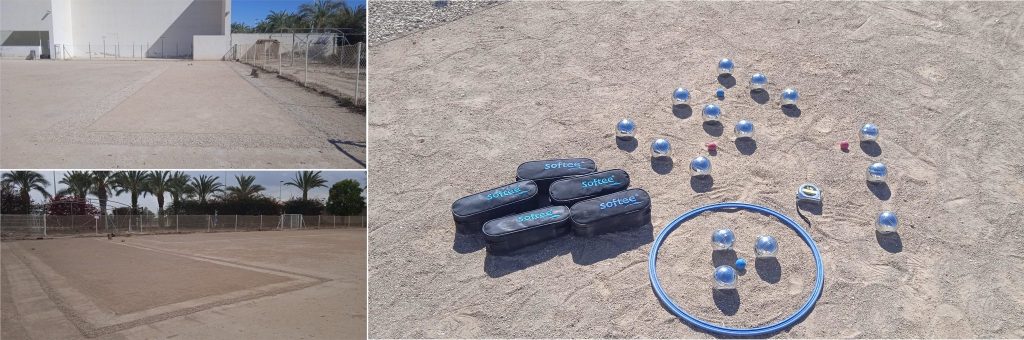
Technical specifications of the playing equipment
The boules
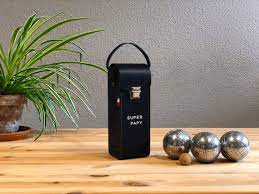
Pétanque boules must meet certain requirements:
- They must be made of steel and must not contain lead or sand inside.
- They must have a diameter of 70.5 to 80 mm.
- They must weigh between 650 and 800 g.
- They may have grooves or patterns on their surface.
The jack
- The jack can be made of wood or approved synthetic material.
- It must have a diameter of 30 mm, with a tolerance of ±1 mm.
- It must weigh between 10 and 18 g.
In the game, the jack is the target that players try to get their boules as close to or hit.
Rules of the game
- At the beginning of the game, a draw determines which team chooses the playing area and throws the jack first.
- The jack is thrown from the throwing circle, with both feet inside the circle and without stepping on its edge, to a distance of between 6 and 10 m.
- Once the jack has been placed, the team that threw it plays first. After that, the team whose boule is furthest from the jack plays.
- The game continues in this way: the team whose boule is furthest away throws until it gets closer than the opponent’s boule or runs out of boules.
- The aim is to get the boules as close to the jack as possible. Boules can also be thrown to hit and move the opposing team’s boules.
- Once all the boules have been thrown, the points are counted. The team with the boule closest to the jack scores one point for each of its boules that is closer to the jack than the opponent’s best boule.
- The position where the jack finishes at the end of the round is used as the reference point for the next one. The throwing circle is placed there and a new round begins.
- If a boule leaves the playing area completely, it is out of the game. If the jack leaves the playing area, the applicable rules are used and, in certain cases, the round may be declared void.