
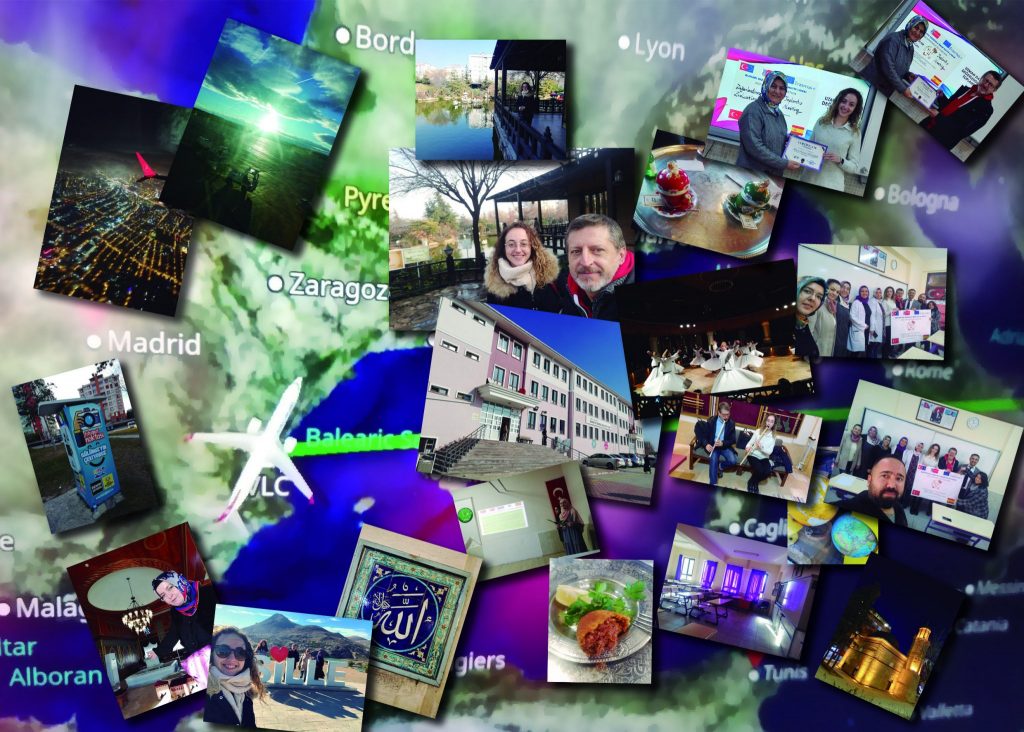
Raul Galvez (Arts department) and Marta Valera, (English language department) carried out a mobility, within the centre’s Erasmus+ project, to Konya, Turkey, where we were living the day-to-day life of the girls’ school of Buhari Kiz Anadolu Imam Hatip Lisesi, from 16th to 22nd January, 2023.
Konya is a major city in central Turkey, on the southwestern edge of the Central Anatolian Plateau, and it is the capital of Konya Province. The population of the Metropolitan Province is of 2,277,017, making it the sixth most populous city in Turkey, and second most populous of the Central Anatolia Region, after Ankara.
We stayed there for week. The first two days, we carried out a seminar about how to improve communication between parents and students. It was a success and more than 70 parents attended the seminar. The first day, the seminar was aimed at teachers from the school and parents. Raul was the one who explained the theory and then, I carried out some activities with them.
The second day was aimed at students. We played the board game “ludus latrunculorum” a strategy game from the Roman Empire similar to chess. Then, we created a “thanks wall”, an activity that helped students reflect on what they are grateful for and finally we did some activities in order to put their oral English skills into practice. The students had a lot of fun and all of them were asking for selfies and signatures when we finished. We felt famous for a day!
The next days, we had the opportunity to walk around the city and try the local food. We visited the Kyoto Japanese Park. Japan in Konya? Yes, that’s right. The Kyoto Japanese Park is a beautiful botanical garden located just a bit outside the city where you feel like you have been teleported from Konya to Kyoto.
Then, we went to the Mevlana Museum, a complex that holds the tomb of the 13th-century religious leader, philosopher, and poet Mevlana Celaleddin Rumi, who founded the whirling dervish sect of Sufism.
We also admired the Ceramic Artistry in the Karatay Tile Works Museum, explored the village of Sille (a tiny village that sits on the edge of the city, 10 kilometers northwest of central Konya) and we even watched the whirling dervish ceremony, the main devotional ritual of the Mevlevi order. The whirling is a form of prayer and meditations that dervishes believe bring them closer to God.
One of the places that I enjoyed the most was “Ecdat Parki”. It is one of the many spectacular parks that you can visit as part of your trip to Konya. This tourist attraction is known for its jaw-dropping display of historical Seljuk and Ottoman style architecture. If you visit Konya, it is undoubtedly a must-see. There, we met the local people and we had the opportunity to learn the traditional art of painting on water from the Ottoman Empire called “Ebru” and we produced even our own work of art in just 5 minutes! We also played “Ney”, one of the most typical instruments of Classical Turkish music and even tried to make pottery.
It was a unique trip, a full cultural immersion. This experience offered us a deep insight into another culture, its languages, food, beliefs, traditions and community. We could meet incredible and generous people who were completely dedicated to ensuring we had the very best and most memorable experience.
Konya you stole our heart!
Marta Valera
English Teacher
Raúl Gálvez (del departament d’Arts) i Marta Valera (del departament de Llengua Anglesa) van realitzar una mobilitat, dins del projecte Erasmus+ del centre, a Konya, Turquia, on vam viure el dia a dia en l’escola femenina Buhari Kiz Anadolu Imam Hatip Lisesi, del 16 al 22 de gener de 2023.
Konya és una ciutat important situada en el centre de Turquia, a l’extrem sud-oest de la Meseta d’Anatòlia Central, i és la capital de la província del mateix nom. La població d’esta província metropolitana és de 2.277.017 habitants, cosa que la convertix en la sisena ciutat més poblada de Turquia i la segona més poblada de la Regió d’Anatòlia Central, després d’Ankara.
Vam romandre allí una setmana. Els dos primers dies vam impartir un seminari sobre com millorar la comunicació entre pares i alumnat. Va ser un èxit i hi van assistir més de 70 pares. El primer dia, el seminari estava dirigit al professorat del centre i als pares. Raúl va ser qui va explicar la teoria i després jo vaig realitzar algunes activitats amb ells.
El segon dia estava dirigit als alumnes. Vam jugar al “ludus latrunculorum”, un joc d’estratègia de l’Imperi Romà paregut als escacs. Després vam crear un “mur d’agraïments”, una activitat que va ajudar els estudiants a reflexionar sobre allò pel que se senten agraïts. Finalment, vam fer activitats per a posar en pràctica les seues habilitats orals en anglés. Els estudiants s’ho van passar molt bé i tots ens demanaven selfies i autògrafs en acabar. Ens vam sentir famosos per un dia!
Els dies següents vam tindre l’oportunitat de passejar per la ciutat i tastar el menjar local. Vam visitar el Parc Japonés Kyoto. ¿El Japó en Konya? Aixina és. El Parc Japonés Kyoto és un preciós jardí botànic situat als afores de la ciutat, on un sent que ha sigut teletransportat de Konya a Kyoto.
Després vam anar al Museu Mevlana, un complex que alberga la tomba del líder religiós, filòsof i poeta del segle XIII Mevlana Celaleddin Rumi, fundador de l’orde sufí dels dervitges giradors.
També vam admirar la ceràmica artística en el Museu de Rajoles de Karatay, vam explorar l’aldea de Sille (un xicotet poble als afores de la ciutat, a 10 quilòmetres al nord-oest del centre de Konya) i fins i tot vam assistir a la cerimònia dels dervitges giradors, el principal ritual devocional de l’orde Mevleví. El gir és una forma d’oració i meditació que, segons els dervitges, els acosta a Déu. Un dels llocs que més vaig disfrutar va ser el “Ecdat Parki”.
És un dels molts parcs espectaculars que es poden visitar en un viatge a Konya. Esta atracció turística és coneguda per la seua impressionant mostra d’arquitectura històrica d’estil seljúcida i otomà. Si visites Konya, sens dubte és una visita obligada. Allí vam conéixer gent local i vam tindre l’oportunitat d’aprendre l’art tradicional de la pintura sobre aigua de l’Imperi Otomà anomenat “Ebru” i de produir la nostra pròpia obra d’art en només cinc minuts. També vam tocar el “Ney”, un dels instruments més típics de la música clàssica turca, i fins i tot vam intentar fer ceràmica.
Va ser un viatge únic, una immersió cultural completa. Esta experiència ens va oferir una comprensió profunda d’una altra cultura, les seues llengües, la seua gastronomia, creences, tradicions i comunitat. Vam poder conéixer persones increïbles i generoses, totalment dedicades a assegurar-se que tinguérem la millor i més memorable experiència possible.
Konya, ens vas robar el cor!
Marta Valera
Professora d’anglés