

Semana del 23 al 27 de Noviembre
Today we have reviewed that…
Cells
All living things are made of very small components called cells. n All cells have the same structure:
- a protective covering that surrounds the cytoplasm: the cell membrane.
- a jelly-like material between the nucleus and the membrane: the cytoplasm.
- a round structure that controls what the cell does: the nucleus.
Cells are so small that they can only be seen using a microscope. They are usually measured in fractions of a millimetre. Cells can be many different shapes: elongated, round, branched or disc-shaped.
So, how can I look at cells?
We use optical microscopes to look at cells and their different parts. The main components of the of the optical microscope the eyepiece (a metal tube with a lens at each end), the objectives (there are usually several), the arm and the base.
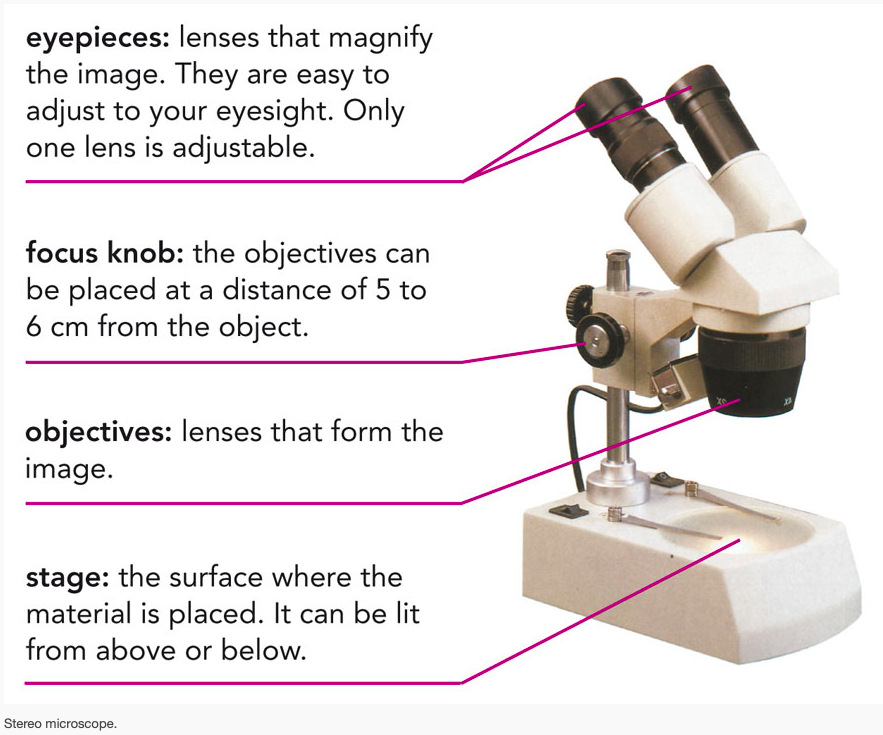
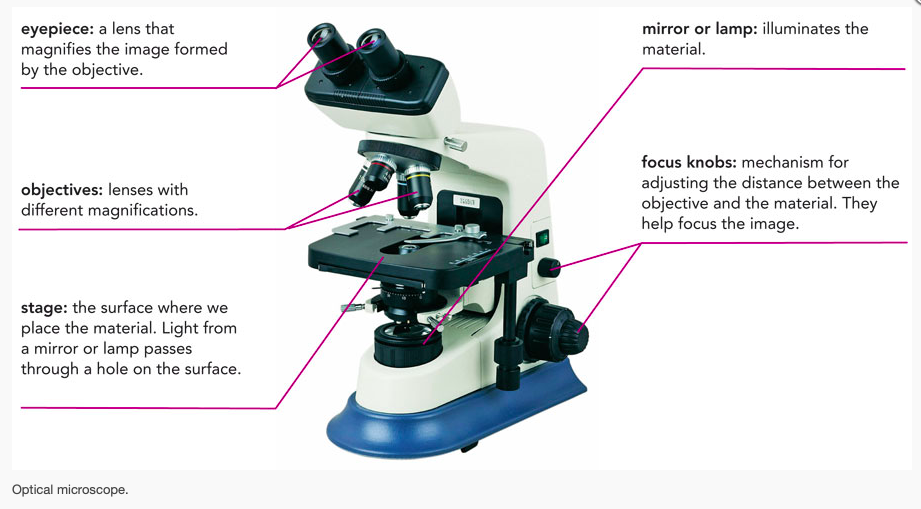
What do we look at with stereo microscopes? And optical microscopes?
Which type of microscope shows objects in more detail?

Unicellular and multicellular organisms
Multicellular organisms contain multiple cells and each cell carries out the three vital functions: it processes substances which pass through the cell membrane, it reproduces by dividing into two and it reacts and interacts with its environment.
In multicellular organisms, cells join together and are organised according to function to form tis- sue. For example, muscle tissue makes up muscles and epithelial tissue makes up the surface of the skin.
In the same way, tissues combine to form organs, such as the liver, heart or brain. These work together to form systems, such as the nervous system or respiratory system.
Unicellular organisms are made up of a single cell. They are very small and can only be seen with a microscope. This is why they are called microorganisms. Plant cells have some characteristics that make them different from animal cells.
Watch these videos to help you undertanding these concepts!

 Anterior