
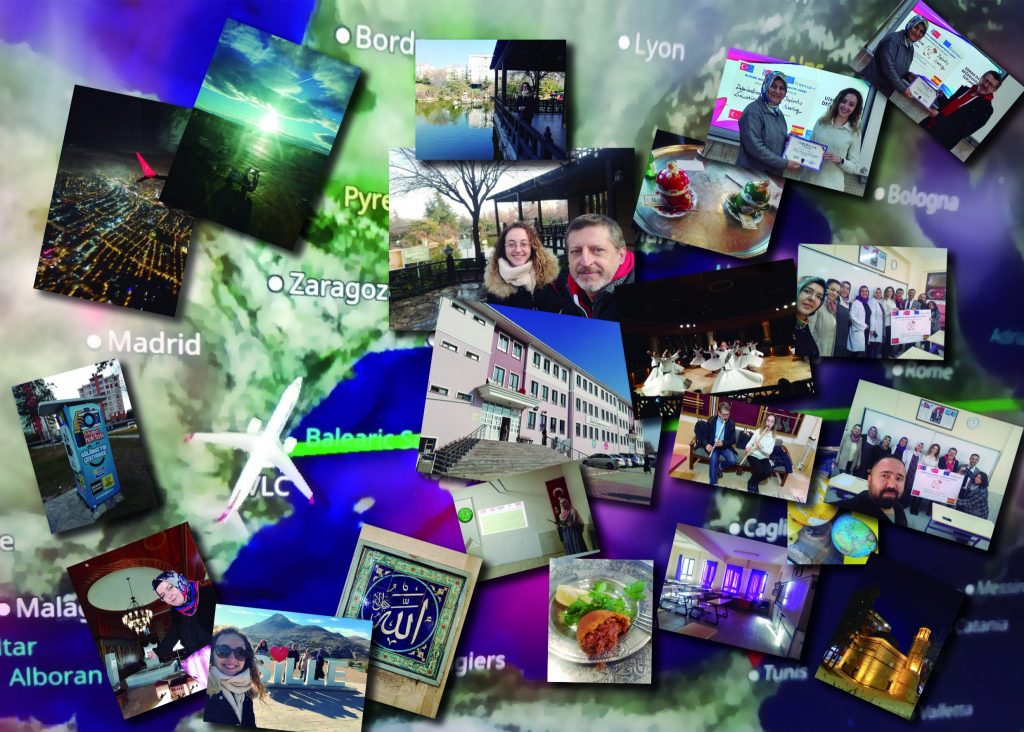
Raul Galvez (Arts department) and Marta Valera, (English language department) carried out a mobility, within the centre’s Erasmus+ project, to Konya, Turkey, where we were living the day-to-day life of the girls’ school of Buhari Kiz Anadolu Imam Hatip Lisesi, from 16th to 22nd January, 2023.
Konya is a major city in central Turkey, on the southwestern edge of the Central Anatolian Plateau, and it is the capital of Konya Province. The population of the Metropolitan Province is of 2,277,017, making it the sixth most populous city in Turkey, and second most populous of the Central Anatolia Region, after Ankara.
We stayed there for week. The first two days, we carried out a seminar about how to improve communication between parents and students. It was a success and more than 70 parents attended the seminar. The first day, the seminar was aimed at teachers from the school and parents. Raul was the one who explained the theory and then, I carried out some activities with them.
The second day was aimed at students. We played the board game «ludus latrunculorum» a strategy game from the Roman Empire similar to chess. Then, we created a «thanks wall», an activity that helped students reflect on what they are grateful for and finally we did some activities in order to put their oral English skills into practice. The students had a lot of fun and all of them were asking for selfies and signatures when we finished. We felt famous for a day!
The next days, we had the opportunity to walk around the city and try the local food. We visited the Kyoto Japanese Park. Japan in Konya? Yes, that’s right. The Kyoto Japanese Park is a beautiful botanical garden located just a bit outside the city where you feel like you have been teleported from Konya to Kyoto.
Then, we went to the Mevlana Museum, a complex that holds the tomb of the 13th-century religious leader, philosopher, and poet Mevlana Celaleddin Rumi, who founded the whirling dervish sect of Sufism.
We also admired the Ceramic Artistry in the Karatay Tile Works Museum, explored the village of Sille (a tiny village that sits on the edge of the city, 10 kilometers northwest of central Konya) and we even watched the whirling dervish ceremony, the main devotional ritual of the Mevlevi order. The whirling is a form of prayer and meditations that dervishes believe bring them closer to God.
One of the places that I enjoyed the most was «Ecdat Parki». It is one of the many spectacular parks that you can visit as part of your trip to Konya. This tourist attraction is known for its jaw-dropping display of historical Seljuk and Ottoman style architecture. If you visit Konya, it is undoubtedly a must-see. There, we met the local people and we had the opportunity to learn the traditional art of painting on water from the Ottoman Empire called «Ebru» and we produced even our own work of art in just 5 minutes! We also played «Ney», one of the most typical instruments of Classical Turkish music and even tried to make pottery.
It was a unique trip, a full cultural immersion. This experience offered us a deep insight into another culture, its languages, food, beliefs, traditions and community. We could meet incredible and generous people who were completely dedicated to ensuring we had the very best and most memorable experience.
Konya you stole our heart!
Marta Valera
Raúl Gálvez (departamento de Artes) y Marta Valera (departamento de Lengua Inglesa) realizaron una movilidad, dentro del proyecto Erasmus+ del centro, a Konya, Turquía, donde vivimos el día a día en la escuela femenina Buhari Kiz Anadolu Imam Hatip Lisesi, del 16 al 22 de enero de 2023.
Konya es una ciudad importante en el centro de Turquía, en el extremo suroeste de la Meseta de Anatolia Central, y es la capital de la provincia de Konya. La población de la provincia metropolitana es de 2.277.017 habitantes, lo que la convierte en la sexta ciudad más poblada de Turquía y la segunda más poblada de la Región de Anatolia Central, después de Ankara.
Permanecimos allí una semana. Los dos primeros días realizamos un seminario sobre cómo mejorar la comunicación entre padres y alumnos. Fue un éxito y asistieron más de 70 padres. El primer día, el seminario estuvo dirigido a docentes del centro y a padres. Raúl fue quien explicó la teoría y luego yo realicé algunas actividades con ellos.
El segundo día estuvo dirigido a los estudiantes. Jugamos al «ludus latrunculorum», un juego de estrategia del Imperio Romano similar al ajedrez. Luego, creamos un «muro de agradecimientos», una actividad que ayudó a los estudiantes a reflexionar sobre aquello por lo que se sienten agradecidos y, finalmente, hicimos actividades para poner en práctica sus habilidades orales en inglés. Los estudiantes se divirtieron mucho y todos nos pedían selfies y autógrafos al terminar. ¡Nos sentimos famosos por un día!
Los días siguientes tuvimos la oportunidad de pasear por la ciudad y probar la comida local. Visitamos el Parque Japonés Kyoto. ¿Japón en Konya? Así es. El Parque Japonés Kyoto es un hermoso jardín botánico situado en las afueras de la ciudad, donde uno siente que ha sido teletransportado de Konya a Kyoto.
Después fuimos al Museo Mevlana, un complejo que alberga la tumba del líder religioso, filósofo y poeta del siglo XIII Mevlana Celaleddin Rumi, fundador de la orden sufí de los derviches giradores.
También admiramos la cerámica artística en el Museo de Azulejos de Karatay, exploramos la aldea de Sille (un pequeño pueblo a las afueras de la ciudad, 10 kilómetros al noroeste del centro de Konya) e incluso asistimos a la ceremonia de los derviches giradores, el principal ritual devocional de la orden Mevleví. El giro es una forma de oración y meditación que, según los derviches, les acerca a Dios. Uno de los lugares que más disfruté fue «Ecdat Parki».
Es uno de los muchos parques espectaculares que puedes visitar en tu viaje a Konya. Esta atracción turística es conocida por su impresionante muestra de arquitectura histórica de estilo selyúcida y otomano. Si visitas Konya, sin duda es una visita obligada. Allí conocimos a la gente local y tuvimos la oportunidad de aprender el arte tradicional de la pintura sobre agua del Imperio Otomano llamado «Ebru» y producir nuestra propia obra de arte en tan solo 5 minutos. También tocamos el «Ney», uno de los instrumentos más típicos de la música clásica turca, e incluso intentamos hacer cerámica.
Fue un viaje único, una completa inmersión cultural. Esta experiencia nos ofreció una profunda comprensión de otra cultura, sus lenguas, su gastronomía, sus creencias, tradiciones y comunidad. Pudimos conocer personas increíbles y generosas, totalmente dedicadas a asegurarse de que tuviéramos la mejor y más memorable experiencia.
Konya, ¡nos robaste el corazón!
Marta Valera
profesora de inglés